
How to Keep a Food Symptom Diary
A food symptom diary helps you connect meals to bloating, cramps, fatigue, brain fog, and other symptoms, and research suggests structured real-time tracking can make trigger patterns easier to identify.

Why a Food Symptom Diary Matters
If you regularly experience bloating, stomach cramps, brain fog, fatigue, or unpredictable bathroom trips, you're not alone. Millions of people live with food-related symptoms every single day, and most of them have no idea which foods are actually causing the problem.
That's where a food symptom diary comes in. It helps you connect what you're eating with how you're feeling in a more structured way. In IBS research, real-time food and symptom diaries have been studied because they can capture symptom timing more accurately than retrospective recall and help clinicians investigate whether symptoms are linked to specific meals or ingredients.[1]
The reason is simple: food reactions are personal. What bothers your gut might be completely fine for someone else. Generic food intolerance lists can't tell you your triggers. Only your own data can.
What the Medical Literature Says
A validated IBS food-and-symptom diary study found that contemporaneous tracking can measure gastrointestinal symptoms as they happen and correlate them with specific aspects of diet.[1] That matters because digestive symptoms often fluctuate through the day, and memory is not always reliable when you try to reconstruct meals and symptoms later.
Broader reviews and clinical guidelines reach a similar practical conclusion: food-related symptoms are common, triggers vary from person to person, and structured diet tracking can support more targeted dietary changes instead of random restriction.[2,3]
What Should You Track?
A good food symptom diary captures three core things: what you ate, how you felt afterwards, and when. The more consistent you are, the clearer the patterns become.
- Meals and snacks: everything you eat and drink, including portion sizes and how the food was prepared.
- Symptoms: bloating, gas, cramps, nausea, fatigue, headaches, skin reactions, brain fog, mood changes, and anything else that feels off.
- Timing: when you ate and when symptoms appeared. Some reactions are immediate, while others take 4 to 12 hours to show up.
- Severity: rate how bad each symptom is. A simple 1 to 5 scale works well.
- Context: stress levels, sleep quality, exercise, and menstrual cycle can all affect your gut and make patterns harder to interpret if you do not track them.
Starting Simple: Pen and Paper
The simplest version of a food symptom diary is a notebook. Grab a blank journal, divide each page into columns for time, food, symptoms, and severity, and start writing. It's free, immediate, and it can make you more mindful of what you're eating.
For some people, a paper diary is enough to spot an obvious trigger. Maybe you notice that every time you eat bread for lunch, you're bloated by 3pm. That's a win. The main goal is not perfection. It is consistency.
But Here's the Problem
Most food reactions are not that obvious. The foods causing your symptoms might be ones you eat every day, which makes them nearly invisible. Reactions can also be delayed by hours, so the meal you blame might not be the real culprit. Some triggers only cause problems in combination with other foods or when you're stressed or short on sleep. This is one reason researchers emphasize real-time logging rather than relying on end-of-week memory alone.[1]
Spotting those hidden patterns in a handwritten notebook is incredibly hard. You need to cross-reference entries across different time windows, track ingredient-level detail, and mentally compare dozens of meals and symptoms. Many people give up after a couple of weeks because the effort feels huge and the insights feel small.
This is exactly the gap that technology can fill.
A Smarter Way: Happy Tummy
Happy Tummy is a gut health app designed to make food symptom tracking faster, more consistent, and easier to review over time.
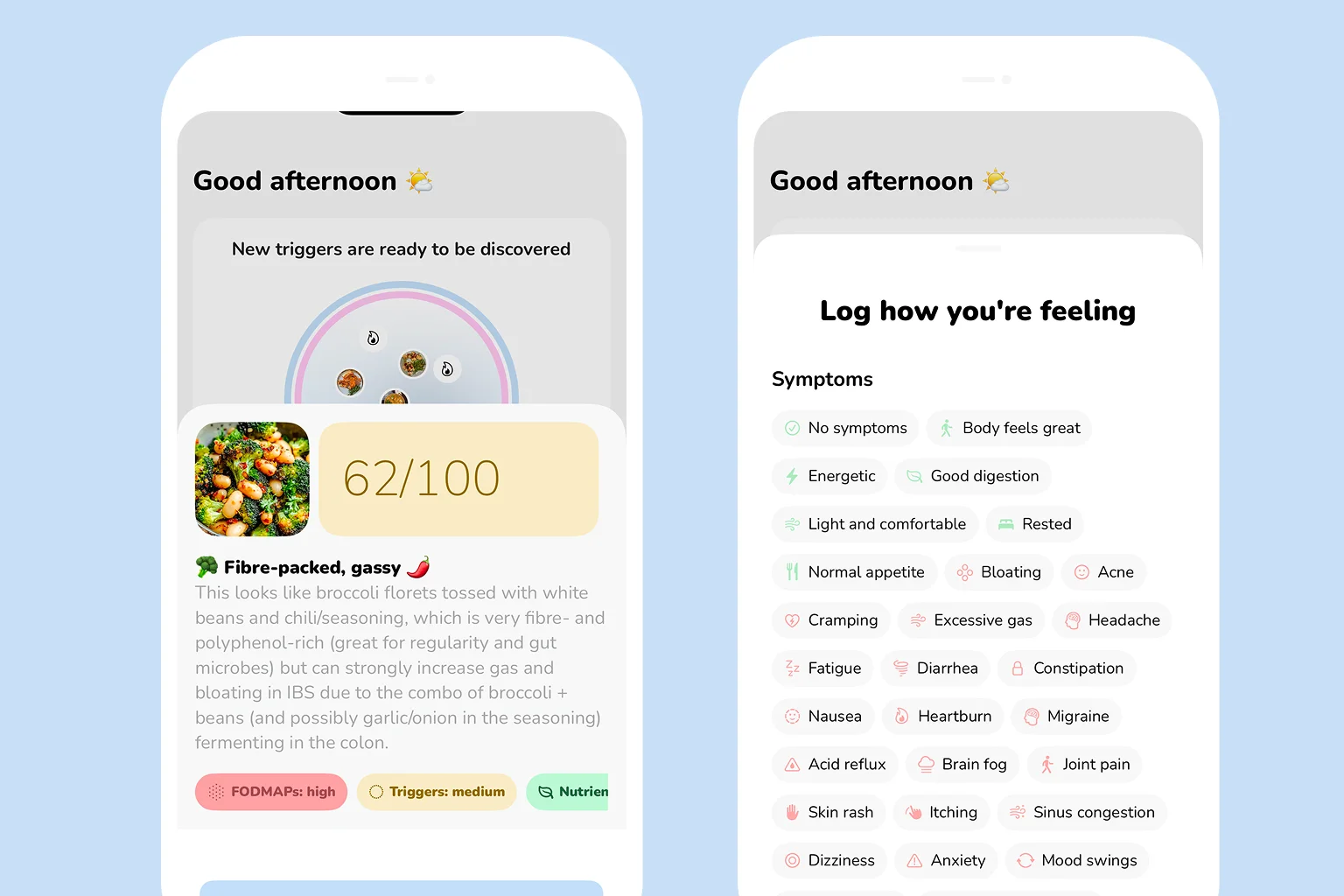
Instead of scribbling down meals and hoping you'll spot a pattern weeks later, Happy Tummy gives you a streamlined logging experience that takes seconds. You log your meals, rate your symptoms, and the app handles the rest.
- Quick meal logging: log what you ate in seconds, not minutes, so the process is easy to stick with.
- Symptom tracking built in: rate symptoms right alongside your meals so nothing gets forgotten.
- Ingredient-level detail: the app breaks meals down into individual ingredients, which is where the real trigger insights often live.
- Consistency over time: the app makes it easier to keep tracking beyond the first two weeks, which is when the most valuable data often starts to emerge.
The Real Game-Changer: AI Pattern Analysis
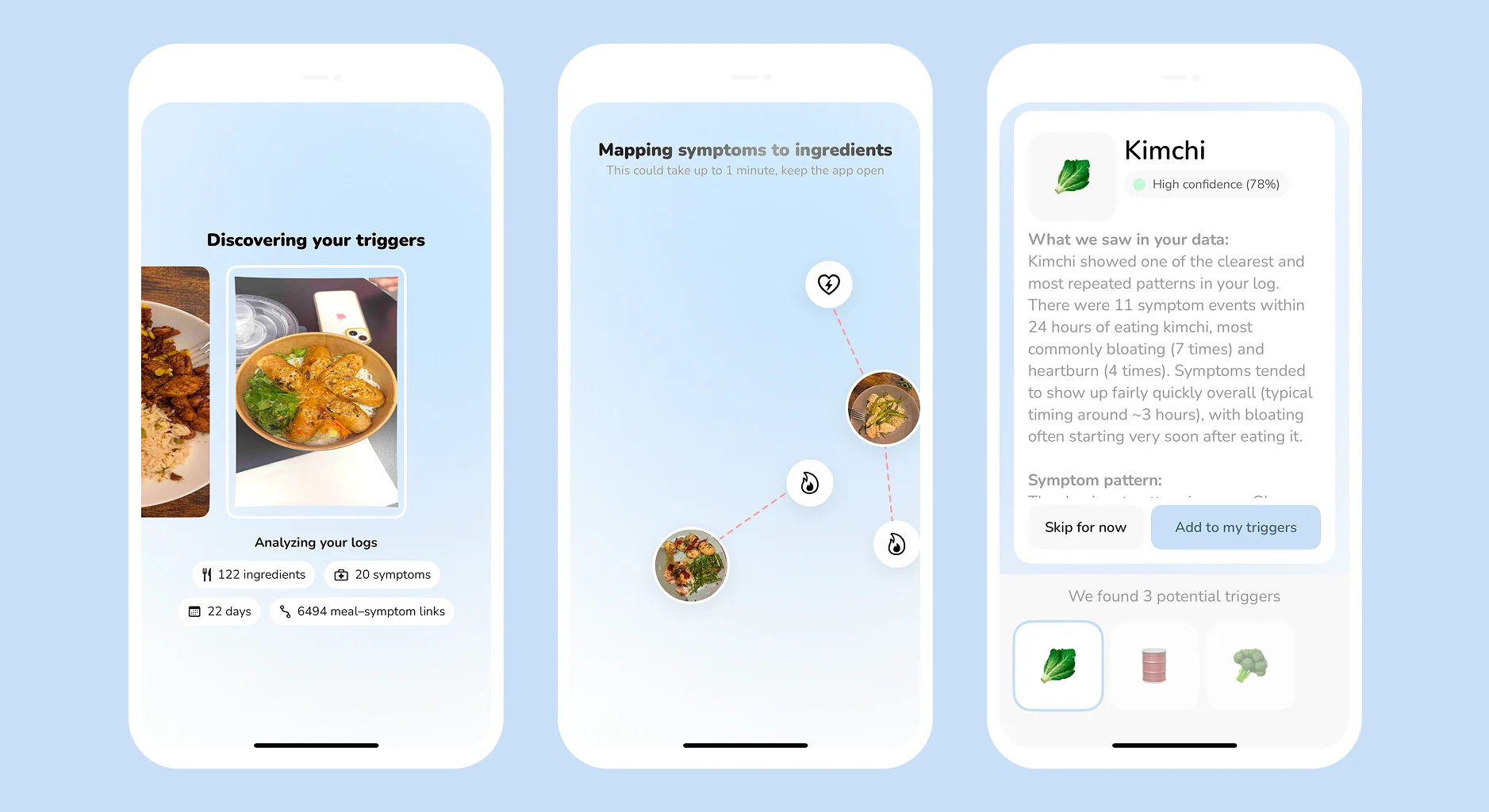
This is where Happy Tummy goes far beyond any diary, whether paper or digital. The app uses AI to automatically analyse your food and symptom data, looking for correlations that would be virtually impossible to spot manually.
It examines patterns across multiple time windows, including reactions that happen within 4 hours, 8 hours, or even 12 hours after eating. It also cross-references individual ingredients against symptom severity and frequency. That kind of structured review is useful because published IBS research consistently shows that symptom patterns differ across individuals rather than following one universal trigger list.[1,2]
That means you do not need to play detective. You do not need to sit down with a spreadsheet and try to figure out whether it was the onion or the cheese that caused Tuesday's bloating. The AI does that work for you continuously in the background, and it gets smarter as you log more data.
- Hidden triggers: foods you eat regularly that are quietly causing low-grade symptoms you've learned to live with.
- Delayed reactions: connections between a food and a symptom that appears hours later, which are easy to miss manually.
- Combination triggers: foods that are fine on their own but problematic when eaten together or in the context of stress, poor sleep, or other factors.
- Confidence levels: the AI does not just guess. It tells you how strong the correlation is so you can prioritise what to test first.
Think of it this way: a pen-and-paper diary is like looking at one puzzle piece at a time. Happy Tummy's AI helps you see the whole picture.
How to Get Started
Whether you choose pen and paper or an app like Happy Tummy, the most important thing is to start. Here's a simple plan:
- Commit to two weeks minimum. Food patterns need time to emerge, so give yourself at least 14 days of consistent tracking before expecting meaningful insights.
- Log everything. Do not skip meals or forget snacks. Data gaps are where insights hide.
- Be specific. 'Lunch' is not useful. 'Chicken Caesar wrap with croutons and parmesan' is.
- Track symptoms promptly. Do not rely on yesterday's memory if you can log how you feel in the moment.
- Do not change your diet yet. The goal is to observe your normal eating patterns first so you have a clear baseline.
Your Gut Has a Story. Start Listening.
A food symptom diary is one of the most practical things you can do for your gut health. It costs little or nothing, requires no medical referral to begin, and gives you a structured record you can use yourself or share with a healthcare professional.
If you've been living with unexplained symptoms and feeling frustrated by vague advice, this is a strong starting point. If symptoms are severe, progressive, or associated with weight loss, bleeding, fever, or nighttime waking, use the diary as a supplement to medical care rather than a replacement for it.[3]
Download Happy Tummy and start tracking today.
References
- Wright-McNaughton M, ten Bokkel Huinink S, Frampton CMA, McCombie AM, Talley NJ, Skidmore PML, Gearry RB. Measuring Diet Intake and Gastrointestinal Symptoms in Irritable Bowel Syndrome: Validation of the Food and Symptom Times Diary. Clinical and Translational Gastroenterology. 2019;10(12):e00103. PubMed
- Gibson PR, Shepherd SJ. Food Choice as a Key Management Strategy for Functional Gastrointestinal Symptoms. The American Journal of Gastroenterology. 2012;107(5):657-666. PubMed
- Lacy BE, Pimentel M, Brenner DM, Chey WD, Keefer LA, Long MD, Moshiree B. ACG Clinical Guideline: Management of Irritable Bowel Syndrome. The American Journal of Gastroenterology. 2021;116(1):17-44. PubMed
Track patterns with Happy Tummy
Use Happy Tummy to log meals, symptoms, and daily habits so you can identify food triggers with more confidence.